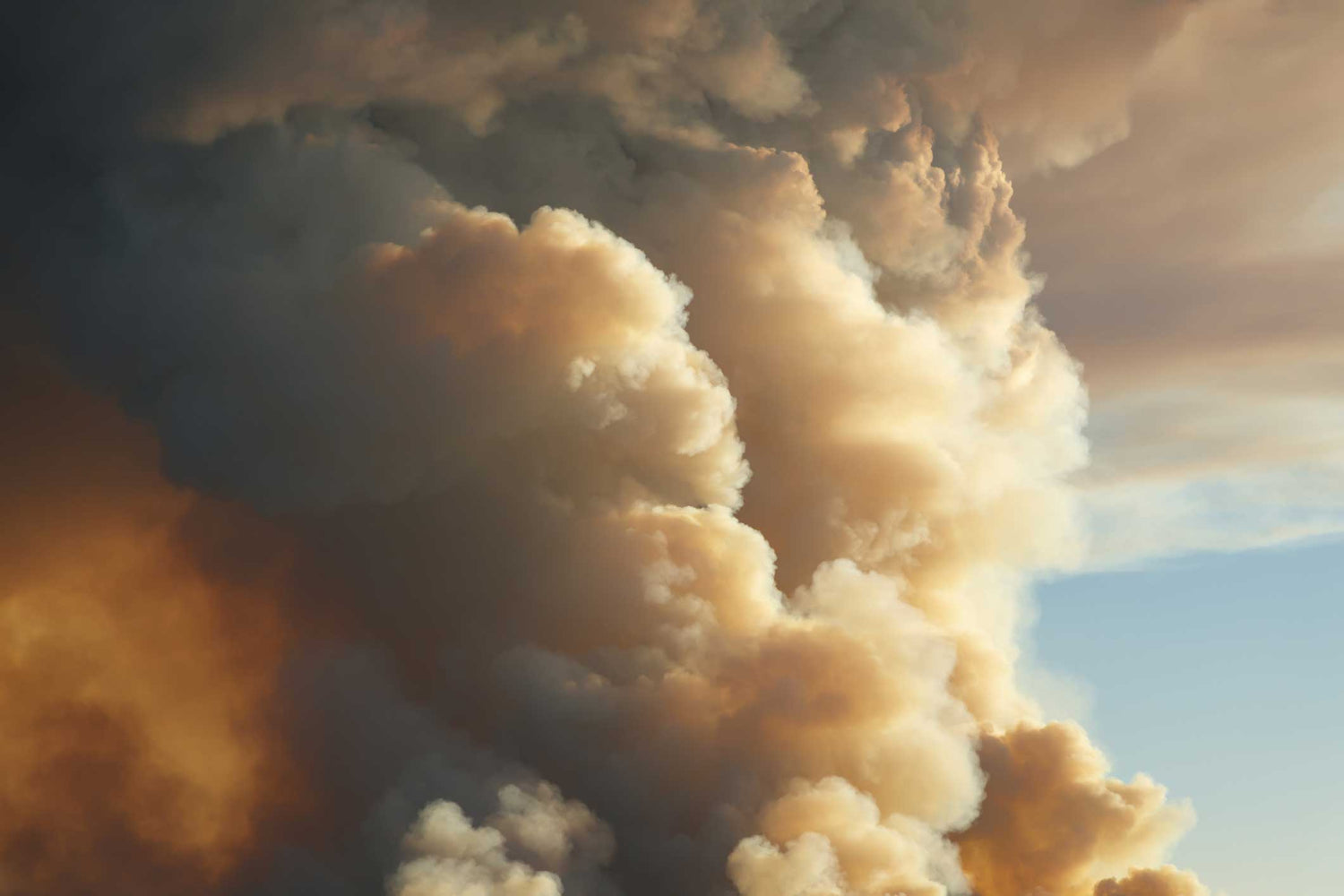
Wildfire Smoke: What Hydroxyls Can Do

What’s actually in the smoke

Often we focus on the particles in smoke, because particles are what you can see and what monitors measure. But they aren't all that matters.

In the FIREX-AQ study, researchers sampled smoke from four fires across Idaho and Washington and measured the gases. Benzene ranged from 0.04 to 25 parts per billion. Modelling chronic exposure, they projected one to nineteen extra cancers per million people. Toluene, ethylbenzene, xylenes and hexane were also measured alongside it.

This isn’t a problem which only affects where the fires occur, either. Smoke influence was detected at background monitoring sites outside the fire zone, with benzene still elevated to 0.5 ppbv. NOAA ranks biomass burning — wildfires included — as the second-largest source of VOC pollution overall.

It gets in, and then it stays

This is the part that surprises people.

Researchers injected smoke into an instrumented house and watched what happened. The VOCs didn’t leave when the smoke did. They moved into the walls, carpets, upholstery and soft furnishings — and once the air cleared, those surfaces reversed direction and became emission sources, feeding the compounds back into the room for days.

Opening windows helped less than you’d expect; the authors found ventilation played “a minor role,” because what governs the process is how the compounds partition into surfaces rather than how much air you move.

In homes affected by the Marshall Fire, VOCs were still measurable weeks later — longer than the researchers expected, by mechanisms not yet fully understood.

It’s why a house can smell of smoke long after the smoke is gone, and why the smell returns on a warm day.

Why a filter can’t reach it

The compounds are in the surfaces, not just the air. A filter can only treat air that passes through it, so it never reaches them. That is not a flaw in filters — it is the boundary of what a filter is.

Hydroxyls work differently. They move through the room and react where the compounds actually are — in the air, and on the surfaces holding them.

Hydroxyl radicals are the atmosphere’s own route for breaking organic gases apart: the radical takes a hydrogen atom, the molecule comes apart, and the chain ends in carbon dioxide and water vapor. It is the dominant removal pathway for most VOCs outdoors, and direct measurements have found the same chemistry running indoors at concentrations comparable to outdoor urban air.

How Hydroxyl Technology Works →
  • Benzene and other VOCs measured in wildfire smoke

    Smoke from four fires in Idaho and Washington: benzene 0.04–25 ppbv, with toluene, ethylbenzene, xylenes and hexane alongside it. Chronic-exposure modelling projected one to nineteen extra cancers per million, against a background of one.

    FIREX-AQ campaign, ACS ES&T Air →

  • Smoke VOCs persist indoors — and surfaces re-emit them

    Smoke injected into an instrumented house. VOCs persisted for days; indoor surface reservoirs became net emission sources once airborne levels fell. Ventilation played “a minor role,” because partitioning into surfaces governs the process.

    Li et al., Science Advances, 2023 →

  • Weeks later, in real homes

    Homes affected by the Marshall Fire retained VOCs for several weeks — longer than expected, by mechanisms the authors say are not fully understood.

    ACS ES&T Air, 2024 →

  • Wildfires are a major source of VOC pollution

    NOAA ranks biomass burning, which includes wildfires, as the second-largest source of VOC pollutants.

    NOAA climate.gov →

  • A particle filter is not a gas filter — the EPA says so

    “Most filters are designed to filter either particles or gases.” The CADR rating is “for particles only,” and for gases the EPA directs you to activated carbon or another gas-specific filter.

    EPA — Guide to Air Cleaners in the Home →

  • Hydroxyls are how the atmosphere removes organic gases

    The hydroxyl radical is the main control on the atmosphere’s oxidation capacity, and reaction with OH is the dominant removal pathway for most VOCs. Direct measurements have found the same chemistry indoors at levels comparable to outdoor urban air.

    Lelieveld et al., ACP, 2016 →
    Atkinson & Arey, Chemical Reviews, 2003 →
    Gómez Alvarez et al., PNAS, 2013 →

  • It releases hydroxyls, with no filter and no UV lamp

    A replaceable cartridge reacts inside the unit to release hydroxyl radicals into the room. One cartridge lasts about three months. Nothing to clog, and nothing that loses capacity as it loads up.

  • It works in the room, not just in the airflow

    Hydroxyls move through the space rather than waiting for air to reach a filter, so they reach the compounds held in carpet, upholstery and soft furnishings as well as the air.

  • A real-time VOC indicator

    The light on the front reads the room’s VOC level: red when contaminants are present, yellow while it works, blue when the air is clear.

  • 0.006 ppm ozone — one eighth of the legal limit

    Intertek, UL 867 Section 40 (2025), against a 0.050 ppm limit. CARB certified and ETL listed, and designed to run in occupied rooms.

    The full ozone record →

What we know, and what we’re still testing

What is established: wildfire smoke carries measurable volatile organic compounds including benzene; those compounds move into indoor surfaces and are re-emitted for days or weeks; and hydroxyl radicals are the atmosphere’s main route for breaking organic gases apart.

What is established about filters: they are built for particles or for gases, not both, and the rating most purifiers advertise covers particles only. That is the EPA’s position.

Where WellisAir fits

WellisAir is one layer, not the whole answer.

The EPA sets out three strategies for indoor air quality, in order: remove the source, improve ventilation, then clean the air. For smoke that order is worth following:

  1. Keep it out while the air is bad. Close windows and doors during a smoke event, and run recirculation rather than drawing outside air in.
  2. Clean the surfaces afterwards. Vacuuming, mopping and dusting physically remove the reservoirs holding smoke compounds. This is the step most people skip, and the research says it matters.
  3. Then treat what’s left. That is our layer — the compounds still in the air and still coming back out of the surfaces, after the sky has cleared and the cleaning is done.

Wildfire smoke questions, answered

Does WellisAir remove wildfire smoke particles?

No. Smoke particles are particles, and this unit has no filter — a HEPA air purifier is what captures them. What hydroxyls act on is the gas side of smoke: the volatile compounds that come in with it and stay behind in the room afterwards.

Why does my house still smell of smoke weeks later?

Because the compounds moved into your surfaces. Researchers who injected smoke into an instrumented house found VOCs persisted for days, and that once the air cleared the surfaces reversed direction and started releasing them back into the room. In homes affected by the Marshall Fire, VOCs were still measurable weeks later.

Won’t opening the windows clear it?

Less than you would hope. The same study found ventilation played “a minor role,” because what governs the process is how the compounds partition into surfaces rather than how much air you move through the room.

What’s actually in wildfire smoke besides particles?

Measured in the FIREX-AQ campaign: benzene from 0.04 to 25 parts per billion, with toluene, ethylbenzene, xylenes and hexane alongside it. Smoke influence reached background monitoring sites outside the fire zone, where benzene was still elevated to 0.5 ppbv.

Does a HEPA filter deal with the gases?

It isn’t built to. The EPA states that “most filters are designed to filter either particles or gases,” and that the CADR rating is “for particles only.” For gases it points to activated carbon or another gas-specific filter.

Should I clean the surfaces?

Yes — vacuuming, mopping and dusting physically remove the reservoirs holding smoke compounds, and it’s the step most people skip. Running a unit afterwards works on what is still in the air and still coming back out.

Does it work on surfaces as well as air?

Both. Hydroxyls move through the room rather than waiting for air to reach a filter, so they reach the compounds held in carpet, upholstery and soft furnishings.

Is it safe to run continuously?

It’s designed for it — no filter, no UV lamp, ozone measured at 0.006 ppm in Intertek’s 2025 UL 867 test (about one eighth of the legal limit), CARB certified, and under 30 dB.